

Personal injury claims are surrounded by assumptions that stop people from seeking advice when they genuinely need it. These myths are rarely based on law. They tend to come from hearsay, outdated ideas, or fear of consequences that do not actually exist.
This blog post addresses some of the most common misconceptions about personal injury claims and explains how the process really works for people living and working in Darlington and the wider County Durham area.
“I’ll be blamed for what happened”
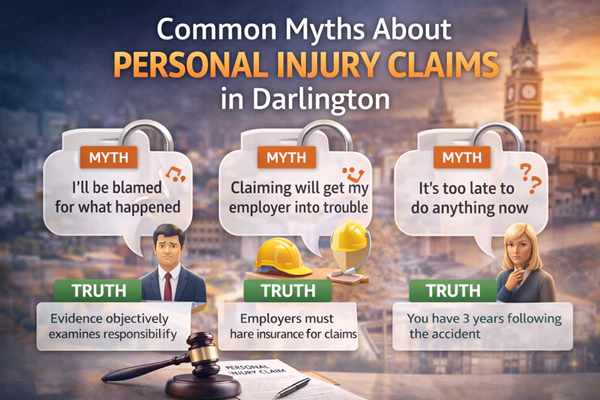
One of the most persistent myths is that making a claim automatically means the injured person is at fault or partly responsible. In reality, personal injury claims exist to examine responsibility objectively, based on evidence.
Many accidents happen because systems fail rather than individuals. Unsafe flooring, poor training, inadequate signage, or faulty equipment are common causes. A claim does not assume blame; it investigates whether reasonable steps were taken to prevent harm.
“Claiming will get my employer into trouble”
This concern is particularly common in workplace injury cases. Employees often worry that raising a claim will financially damage their employer or lead to disciplinary action.
In most cases, compensation is paid by thpe employer’s insurer, not directly by the business. Employers are legally required to hold insurance for this reason. A claim isn’t an accusation of bad character; it’s a process to address harm when safety standards are insufficient.
In Darlington, many claims arise from routine workplace incidents rather than serious misconduct, and they are handled as part of normal insurance procedures.
“If my injury wasn’t serious, I shouldn’t claim”
People often downplay injuries, especially when symptoms develop gradually. Back pain, repetitive strain injuries, or soft tissue damage may not feel serious at first but can affect work and daily life over time.
The seriousness of an injury is not measured solely by how dramatic it appears at the scene. What matters is the impact on mobility, comfort, employment, and recovery. Minor injuries on paper can still justify a claim if they disrupt normal life.
“It’s too late to do anything now”
Another common misconception is that if time has passed since the accident, no action can be taken. Personal injury claims are subject to time limits; these limits are longer than many people realise.
In most cases, a claim can be brought within three years of the accident or at the point when the injury became known. This is particularly relevant where symptoms appear slowly or worsen over time. Seeking early advice can help determine if time is still in your favour.
“The process will be stressful and confrontational”
Many people imagine personal injury claims as hostile disputes involving court appearances and aggressive questioning. In reality, most claims are resolved through correspondence and negotiation, without court proceedings.
Solicitors are trained to manage communication with insurers and other parties on your behalf. The aim is usually resolution, not confrontation. While some claims do proceed further, this scenario is far less common than people expect.
“I’ll have to pay even if I lose”
Fear of costs stops many people from seeking advice at all. Modern personal injury funding arrangements are designed to reduce financial risk, particularly for individuals with legitimate claims.
Before making any commitment, a solicitor should clearly explain the funding. Understanding this early often removes unnecessary anxiety and allows people to focus on recovery rather than financial uncertainty.
“Only certain people can make a claim”
Some believe that personal injury claims are only for specific professions or extreme accidents. In reality, claims arise across all sectors, from office work and care roles to construction, retail, and driving-related work.
Accidents do not discriminate by job title. Legal rights apply broadly, regardless of employment type, as long as negligence can be shown.
Why myths persist and why clarity matters
These misconceptions persist because people rarely see the full process unless they go through it themselves. Advertising slogans and online commentary often simplify complex legal processes, creating confusion rather than clarity.
Understanding what personal injury claims actually involve allows people to make decisions based on facts, not fear. For those in Darlington, access to accurate information early on can prevent unnecessary stress and ensure options remain open.
Separating myth from reality before deciding
Seeking legal advice does not mean committing to a claim. It means replacing uncertainty with information. Dispelling myths puts people in a better position to determine if pursuing a claim is suitable for their circumstances.
Clarity, rather than assumption, is usually the most valuable first step.