

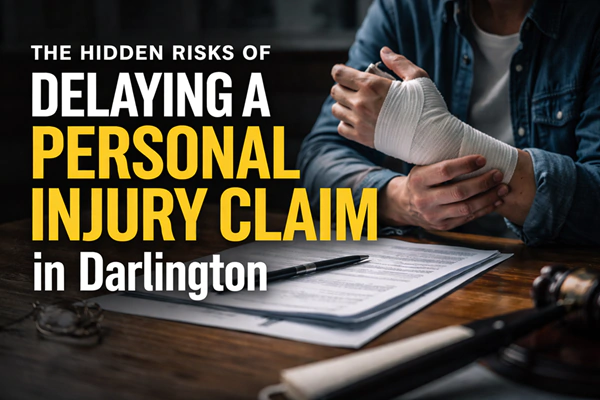
After an accident, many people decide to wait. They want to see how they feel, avoid making a fuss, or give things time to settle. On the surface, that decision feels reasonable and low-pressure. Life carries on, symptoms are managed, and the incident slowly fades into the background.
What often goes unnoticed is how delay can quietly change the landscape around a potential personal injury claim, even when no immediate action is intended.
What people usually expect when they wait
Most people assume that waiting simply pauses things. They believe they can return to the issue later if pain persists or circumstances change. They believe that taking time to reflect does not result in any loss.
This assumption is usually driven by something other than avoidance. It usually comes from a desire to focus on recovery, work, or family without adding legal stress into the mix. Many people also assume that records will always be there if they are needed later.
What actually changes in the background
While someone waits, the world around the incident continues to move. Records are archived, staff change roles, and day-to-day details lose clarity. None of such change is dramatic or deliberate, but it has an effect.
In personal injury cases, context matters. As time passes, it becomes harder to prove how an accident happened, who was there, what was said, and how symptoms developed. Even when records still exist, they may no longer capture nuance or explanation, only outcomes.
How time quietly affects evidence
Evidence usually remains for some time. Instead, it weakens gradually.
Memories become less precise as people unconsciously fill gaps with assumption. Witnesses move on to new roles or new employers. CCTV footage is routinely overwritten. Workplace layouts, processes, or supervision arrangements may change. Medical notes focus on treatment rather than cause as time goes on.
Each individual change may seem insignificant. Taken together, they can make it harder to reconstruct events with confidence, particularly where responsibility is not immediately obvious.
This is especially relevant in Darlington, where many claims involve shared workspaces, rotating staff, or public-facing environments where detailed records are not preserved indefinitely unless there is an early reason to do so.
Why this matters even if no claim is made
Understanding the impact of delay is not about pushing people toward legal action. It is about preserving clarity.
Even if a claim is never pursued, early understanding of what happened and how injuries relate to the incident can be reassuring. It allows people to draw a clear line under events rather than leaving questions unresolved.
For some, that clarity removes the feeling that something important was overlooked or mishandled. For others, it confirms that no further action is needed, which can be just as valuable.
The local context behind timing
In County Durham, timing can interact with practical realities in subtle ways. NHS assessment pathways may involve waiting periods. Employers may rotate managers or restructure teams. Insurers may handle incidents in batches rather than individually.
When time passes, linking symptoms back to an incident can become more complex, particularly where injuries worsen gradually or fluctuate. This does not mean a claim becomes impossible, but it can introduce uncertainty that did not exist at the outset.
The cost people rarely anticipate
The most overlooked consequence of delay is not financial. It is mental.
Unanswered questions tend to linger. People replay conversations, revisit decisions, and wonder whether acting earlier would have changed anything. That background uncertainty can sit alongside recovery and resurface long after physical symptoms improve.
Having accurate information early often removes that weight, regardless of what decision follows.
Reframing delay as a choice, not a default
Taking time after an accident is not wrong. What matters is whether that time is informed or automatic.
Delay can be a conscious decision made with understanding, or it can happen by default because no information was available when it mattered most. The difference between the two is control.
Clarity before pressure
Personal injury claims are rarely urgent in the legal sense, but clarity is valuable early on. Knowing how delay affects evidence, options, and understanding allows people to move forward without unnecessary doubt.
For those in Darlington, that clarity can make the period after an accident feel more manageable, regardless of whether a claim is ever pursued.