

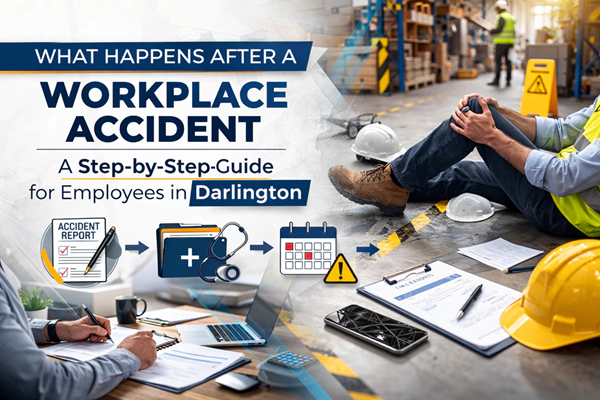
A workplace accident rarely ends when the immediate incident is over. For many people, the confusion begins afterwards, once the shock has worn off and questions start to surface. Could you please clarify who should be informed, which evidence is important, and the timeframe for deciding whether to proceed further?
This blog explains what typically happens after a workplace accident, from the first few days through to the point where a personal injury claim may be considered, with specific reference to employees working in and around Darlington.
The first few days: Reporting and recovery
In the immediate aftermath of a workplace accident, the priority is always health. Even injuries that seem minor at first can worsen once swelling or strain develops, particularly with back, neck, or joint injuries.
From a legal perspective, early reporting matters. Most workplaces in Darlington, including offices, warehouses, factories, and construction sites, are mandated to maintain an accident book. Recording what happened as soon as possible creates a contemporaneous record that may become important later.
At this stage, many employees worry about “making a fuss” or damaging relationships at work. In actuality, reporting an accident does not imply filing a claim; rather, it is a standard safety procedure. It simply documents that an incident occurred.
Medical evidence and why timing matters
Medical assessment plays a central role in workplace injury claims. Even if you attend A&E or your GP shortly after the accident, further symptoms may develop days or weeks later.
In County Durham, medical evidence often comes from a combination of NHS records and independent medical experts. The timing of these assessments matters because medical reports link the injury to the accident itself. Delays can make that link harder to establish, particularly if symptoms are intermittent or worsen gradually.
A solicitor will usually advise waiting until the injury has stabilised before valuing a claim rather than rushing to settle it before the full impact is understood.
Employer responsibility and fault
Many people assume that making a workplace injury claim means accusing their employer of deliberate wrongdoing. In most cases, that is not how claims arise.
Employers have a legal duty to provide a safe working environment. Claims typically relate to failures in risk assessment, training, equipment maintenance, or systems of work. These are usually insured, meaning compensation is paid by the employer’s insurer rather than directly by the business.
In Darlington, where many employers operate across logistics, manufacturing, care, and construction, claims often involve routine safety oversights rather than dramatic incidents.
How evidence builds over time
Workplace injury claims typically require multiple pieces of evidence, unlike road traffic accidents. Instead, they develop gradually.
Witness statements, accident reports, training records, and maintenance logs may all become relevant. Over time, medical reports provide clarity on the extent of injury and prognosis. This slow accumulation of evidence is normal and does not mean a claim is weak.
Understanding these facts helps manage expectations. Workplace claims often take longer because evidence is gathered methodically, not because anything is going wrong.
Why time limits matter more than people realise
In most cases, there is a three-year time limit to bring a personal injury claim, starting with the date of the accident or when the injury became known. While that may sound generous, delays can cause problems.
Memories fade, staff move on, and records may become harder to obtain. For this reason, many solicitors advise seeking legal advice well before the limitation period becomes an issue, even if a claim is not pursued immediately.
Early advice does not force action. It preserves options.
The emotional side of workplace injuries
Workplace accidents often affect more than physical health. People may feel anxious about returning to work, concerned about job security, or frustrated by on-going symptoms.
These concerns are common and do not weaken a claim. In fact, psychological effects can contribute to the overall impact of an injury, especially when it affects confidence or independence.
A good solicitor will recognise these pressures and take them into account when giving advice on next steps.
When legal advice becomes helpful
Not every workplace accident leads to a claim. However, legal advice becomes particularly valuable where injuries persist, time off work is required, or employers dispute what happened.
Speaking to a solicitor does not commit you to taking action. It allows you to understand where you stand, what evidence exists, and whether pursuing a claim would be proportionate in your circumstances.
For employees in Darlington, early clarity often reduces stress, regardless of whether a claim proceeds.
Understanding the process before making a decision
The most important thing after a workplace accident is understanding the process before decisions are made under pressure. Claims are usually not urgent in the legal sense, but good information early on can prevent mistakes later.
Knowing what typically happens, how evidence develops, and where responsibilities lie allows injured workers to make informed choices based on facts rather than assumptions.